
Overview
As businesses strive for greater efficiency and innovation, the need for robust and adaptable CRM solutions has never been higher. Migrating from Salesforce to Dynamics 365 presents an opportunity to not only streamline operations but also unlock new capabilities that drive better customer engagement and business growth.
If you are contemplating a move from Salesforce to Dynamics 365, you're not alone. According to a recent report, 70% of all CRM software investments in 2023 were directed towards Dynamics 365, highlighting a major shift towards this platform as businesses recognize its powerful capabilities and future-proof infrastructure.
Migrating from Salesforce to Microsoft's Dynamics 365 offers improved data management, enhanced automation, and seamless integration with a wide range of business applications. However, the transition requires careful planning and detailed execution.
Why Consider Migrating from Salesforce to Dynamics 365?
Before diving into the technical steps, here are the key reasons businesses are making the switch:
Comprehensive CRM & ERP Integration
Dynamics 365 seamlessly integrates CRM and ERP functionalities in one platform, eliminating silos and delivering scalable solutions that grow with your business.
Advanced Analytics & AI-Driven Insights
Built-in AI and machine learning enable predictive analytics, automating lead scoring, sales forecasting, and customer service management. Power BI integration powers rich, data-driven decisions.
Cost-Effective, Flexible Pricing
A pay-per-user subscription model means businesses only pay for what they need — particularly economical for organizations already invested in the Microsoft ecosystem.
Security, Compliance & Microsoft Integration
Dynamics 365 adheres to GDPR, ISO, and SOC compliance standards and integrates effortlessly with Power BI, Outlook, Teams, Azure, and Office 365 for unified, connected workflows.
Step-by-Step Migration Guide
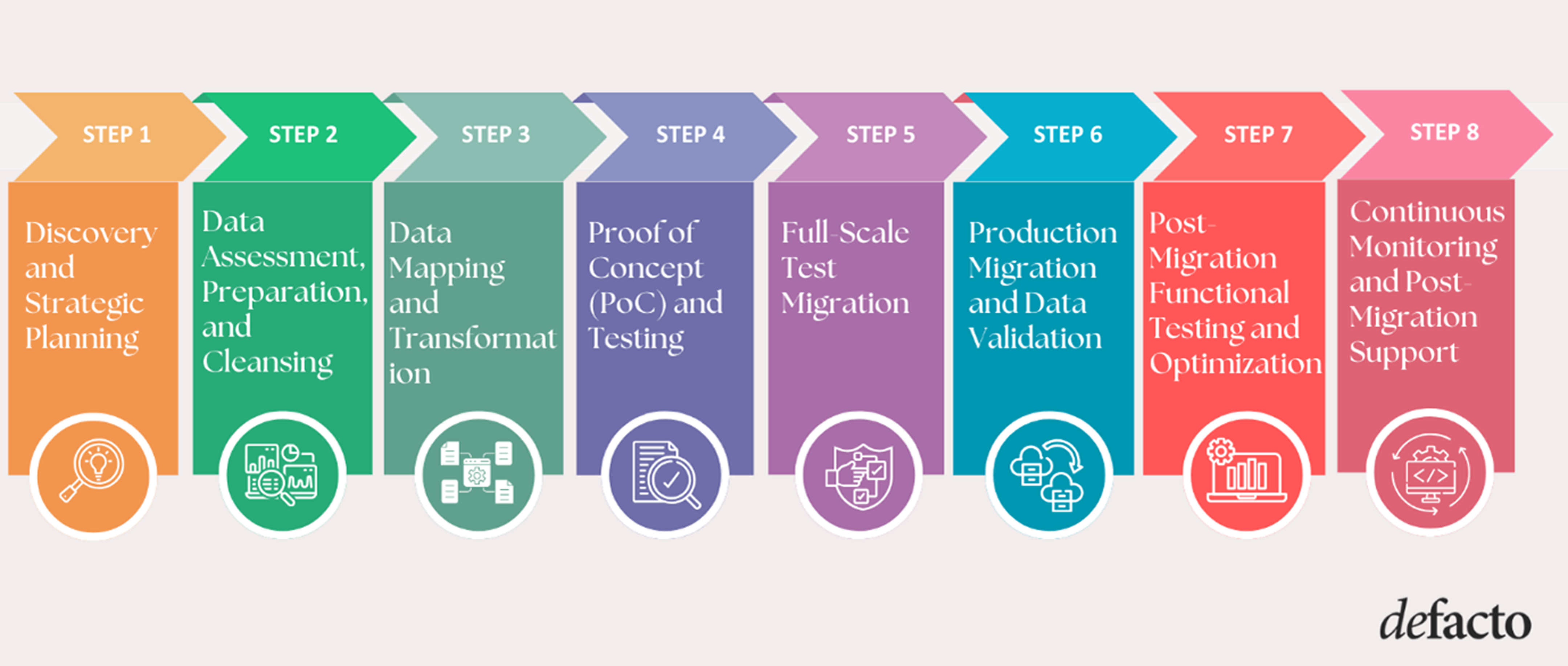
Discovery & Strategic Planning
In-depth analysis of your Salesforce environment, defining migration goals and a tailored strategy aligned to your business objectives.
Data Assessment & Cleansing
Thorough data quality analysis — removing duplicates, fixing inconsistencies, and ensuring only clean, validated data is migrated.
Data Mapping & Transformation
Meticulous field-level mapping between Salesforce and Dynamics 365 data models, preserving relationships and custom objects throughout.
PoC & Test Migration
Controlled Proof of Concept validates mapping rules and data quality before a full-scale test migration across all modules and objects.
Production Migration & Validation
Full data transfer using KingswaySoft or Microsoft's Data Migration Assistant, followed by in-depth field-by-field validation.
Training & Ongoing Support
Role-based training, User Acceptance Testing, continuous monitoring, and post-migration support to maximize adoption and ROI.
Key Benefits of Migrating to Dynamics 365
-
Improved Business Insights — built-in AI, analytics, and Power BI deliver a unified view of customer data for data-driven decisions.
-
Increased Operational Efficiency — automated workflows and data synchronization reduce manual intervention across the business.
-
Customizability & Scalability — Power Apps and Power Automate make Dynamics 365 adaptable to any industry or business size.
-
Seamless User Experience — the familiar Microsoft interface reduces the learning curve, enabling quick adoption and improved productivity.
Wrapping Up
Transitioning from Salesforce to Dynamics 365 is more than a data migration — it's an opportunity to transform how your business operates, engages customers, and makes decisions. At De Facto, we specialize in ensuring your migration is seamless and tailored to your specific needs, helping you fully leverage the potential of this powerful platform.